

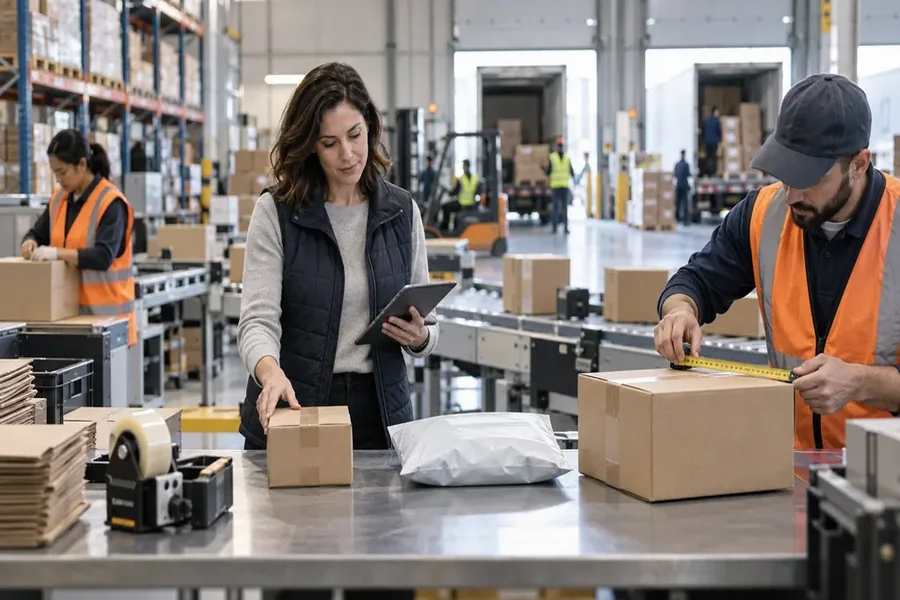
Weight isn’t the only thing a carrier charges for. Box size counts just as much. A lightweight product rattling around in a big carton can take up more carrier space than its weight suggests, and that space costs money.
That’s dimensional weight. If you ship hundreds or thousands of orders, the box your warehouse team grabs becomes a line item. Whether you pack in-house or lean on ecommerce fulfillment services, picking the right box isn’t only about protecting the product. It’s about not paying to ship air.
What is dimensional weight?
Dimensional weight, sometimes called volumetric weight, is how carriers price the space a package occupies in transit.
Carriers typically take the length, width, and height, then divide by a figure set by the carrier and the service. That result gets compared with the actual weight, and depending on the carrier’s rules, the higher of the two often becomes the billable weight.
Take a two-pound product packed in an oversized box. Its dimensional weight can come out higher than its real weight, so the charge reflects the box, not what’s inside it.
The exact calculation varies by carrier, service, and account agreement. Check the rules that apply to your account instead of assuming.
How oversized packaging increases shipping costs
Grabbing a box much bigger than the product needs is a common mistake. Usually the warehouse only has a few box sizes on the shelf, or nobody checked the product dimensions when the order was packed.
Good pick and pack fulfillment starts with matching the carton to the product before anything goes in. When that step gets skipped, a few things follow. Dimensional weight climbs, even on light products. Bigger boxes pull in more cushioning and void fill to stop items from shifting. Larger parcels also eat staging space in the warehouse and room in the trucks. And on low-value orders, the extra shipping cost can swallow whatever margin was left.
On one order, none of this looks like much. Repeated across a catalog, it adds up fast.
Why the smallest box isn’t always the best choice
Shrinking the package doesn’t mean grabbing the tiniest box available. It still has to survive handling and transit.
A box that’s too snug leaves no room for cushioning. Fragile products often need protective inserts, and oddly shaped items may need packaging built around them.
So the goal is balance. A small accessory might ship safely in a padded mailer instead of a full box. A fragile item might need a fitted carton. An order with several items might genuinely need the bigger package, though even then, arranging products carefully can cut the empty space.
Practical ways to improve packaging efficiency
A handful of changes can trim avoidable dimensional weight costs.
Keep several carton sizes on hand. Packing teams work better with options, and defaulting every order into the same large box pushes dimensional weight up for no reason.
Get your measurements right. Reliable length, width, and height for each SKU let teams estimate packaging needs ahead of time and flag anything that needs special handling. If you sell through Shopify, this is where your product catalog data earns its keep, and it’s also the information any provider of Shopify fulfillment services will need from you to pack accurately from day one.
Look hard at whatever ships most. If one SKU keeps landing in oversized packaging, that’s a sign to test a better-fitting carton or mailer.
Cut the empty space. That comes down to careful arrangement and the right amount of cushioning, enough to stop movement and not so much that it fills an oversized box.
Give multi-item orders their own look. The right carton plus smart arrangement can often fit more into less space than you’d expect.
Compare carrier rules directly. Different carriers and services calculate dimensional weight differently, so understand how package size affects charges on the services you actually use.
The role of a fulfillment partner
Packaging efficiency gets harder to hold as order volume grows. Different product sizes, bundles, fragile items, and orders coming in from several sales channels all pull in different directions. Without something consistent tying it together, packaging decisions drift from one order to the next.
That’s where 3PL warehouse services help. A repeatable packing workflow lets warehouse teams rely on product dimensions and handling instructions to choose the right materials every time, not whatever box is closest.
Boost3PL’s pick and pack service covers secure packaging for standard, fragile, and bundled orders, with custom packaging and branding available. It supports brands selling through Shopify, Amazon, and TikTok Shop.
Channel matters here too. If you’re building out TikTok Shop fulfillment alongside your other storefronts, consistent packaging decisions across all of them matter just as much as they do on any single platform.
Make packaging part of your cost strategy
Boost3PL’s warehouse in North Bergen provides warehouse fulfillment New Jersey brands can use for order processing, packing, and shipping from a U.S. location.
Shipping costs come down to more than distance and weight. Package dimensions, carrier rules, protective materials, and how products are arranged inside the box all feed the final number.
A closer look at packaging can help e-commerce brands find avoidable costs without giving up product protection. The right carton sizes, accurate measurements, and consistent packing habits all push shipping toward running more efficiently.
Treat package size as part of fulfillment strategy and not an afterthought, and you protect a lot more margin on every order.
